
How a New Product Development Company Guides Products From Concept to Launch
A new product development company can give founders and product teams one coordinated path from an early opportunity through engineering, prototypes, manufacturing, and launch. The value is not simply access to more services. It is having the right questions answered, risks reduced, and decisions made in the right order.
Developing a physical product rarely follows a perfectly straight line. A concept may reveal a technical limitation. A prototype may expose a usability problem. A supplier may identify a manufacturing constraint that requires a design change. Customer feedback may alter the feature priorities or positioning.
These discoveries are normal. The challenge is managing them without losing the original customer need, commercial objective, or technical logic behind the product.
A capable new product development company helps a team navigate that uncertainty. It coordinates the business, design, engineering, prototyping, testing, sourcing, and manufacturing decisions required to move a product from concept to launch.
The NIST Manufacturing Extension Partnership describes product development as a connected process that can include market validation, development, prototyping, manufacturing, distribution, and launch. That connection matters because decisions made during one stage often determine what is possible, affordable, and reliable in the next.
What a New Product Development Company Actually Coordinates
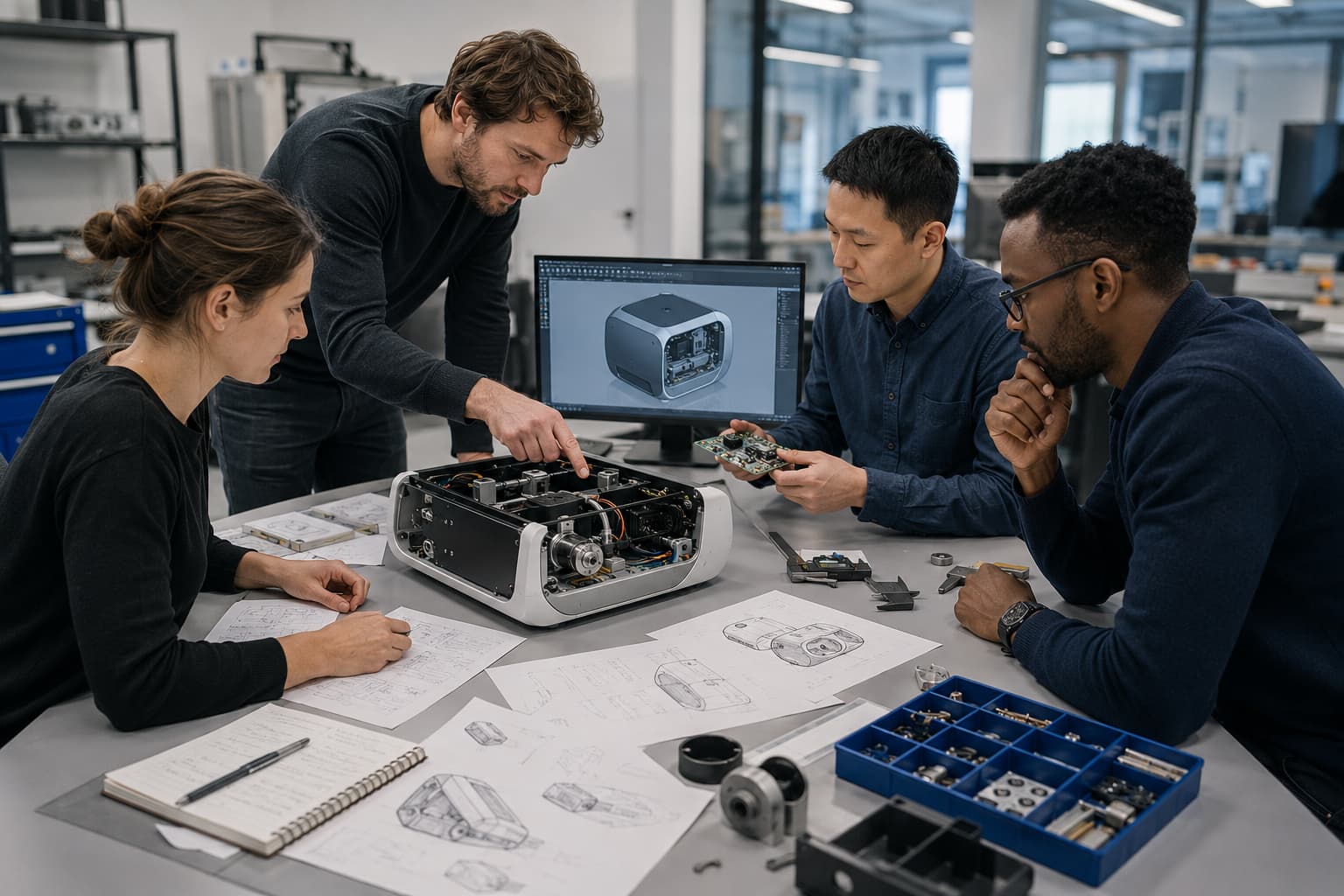
A new product development company helps turn an opportunity or idea into a product that can be built, sold, supported, and improved. The work may involve industrial design, mechanical engineering, electrical engineering, embedded systems, software, prototyping, testing, sourcing, manufacturing preparation, and commercialization planning.
The exact mix depends on the product. A connected device may require sensors, firmware, wireless communication, a cloud platform, and regulatory testing. A mechanical product may depend more heavily on material selection, structural performance, mechanisms, assembly, and manufacturing processes.
The essential feature is not that every project uses every discipline. It is that the company understands how the disciplines affect one another and can coordinate them around a shared product objective.
Our broader guide to what a product development company actually does explains the common capabilities in more detail. For teams evaluating full-lifecycle support, the more important question is how those capabilities are organized from one stage to the next.
Stage 1: Define the Opportunity Before Defining the Product
Early product conversations often begin with a proposed solution. A stronger development process begins by clarifying the problem, customer, use environment, and commercial opportunity.
The development company should help the team establish:
- The target user and the problem the product must solve
- The conditions in which the product will be used
- The most important customer and business outcomes
- Initial pricing, volume, and cost assumptions
- Required features and optional features
- Known technical, regulatory, and manufacturing constraints
- The evidence needed to justify further investment
This work does not need to eliminate uncertainty. Its purpose is to make uncertainty visible and prioritize what the team must learn first.
Founders can explore this stage further in our guide to validating a product idea before building.
Stage 2: Translate the Opportunity Into Product Requirements
Once the opportunity is understood, the team can convert customer and business needs into product requirements. These requirements give designers, engineers, and commercial stakeholders a common frame of reference.
A requirement might describe size, weight, operating time, load capacity, environmental resistance, connectivity, safety, service life, manufacturing cost, or a critical user interaction. Requirements should be specific enough to guide decisions but flexible enough to evolve as the team learns.
A good development partner will also distinguish between assumptions and verified requirements. A founder may believe customers need a particular feature, for example, but early research may show that reliability or ease of setup matters more.
This prevents an attractive concept from becoming overdesigned around untested assumptions.
Stage 3: Explore Concepts and Establish the Product Architecture
Concept development is where the team investigates different ways to satisfy the requirements. Industrial designers may explore form, user interaction, and ergonomics. Engineers may compare mechanisms, components, materials, manufacturing processes, and system architectures.
The objective is not to polish the first idea. It is to identify a direction that balances customer value, technical feasibility, cost, schedule, and manufacturing reality.
For multidisciplinary products, this stage should also define the major interfaces between mechanical components, electronics, firmware, software, and external systems. Unclear interfaces are a common source of late integration problems.
A strong concept is not merely appealing. It creates a credible path to the required performance, cost, manufacturing process, and customer experience.
Stage 4: Engineer and Prototype the Highest-Risk Questions
Engineering turns the selected direction into a system that can be analyzed, built, and tested. The team develops the geometry, mechanisms, circuits, controls, interfaces, materials, and technical documentation needed to make the product function.
Prototypes should be planned around questions rather than appearance alone. One prototype might test a mechanism. Another might evaluate ergonomics. A functional engineering prototype may integrate mechanical, electrical, and software systems. A later prototype may closely represent production materials and assembly methods.
The partner should explain what each prototype is intended to prove, what it cannot prove, and what decision will follow the test.
This is also where integrated product engineering services become especially valuable. Mechanical, electrical, firmware, and software decisions often need to evolve together. Treating them as isolated workstreams can create incompatible interfaces or late-stage redesigns.
Stage 5: Test, Learn, and Verify the Design
Testing should begin early and become more formal as the design matures. Early tests may be exploratory. Later tests should verify that the product satisfies defined requirements under realistic conditions.
Depending on the product, testing may examine:
- Functional performance
- Durability and repeated use
- Temperature, moisture, dust, vibration, or impact exposure
- Battery life and power consumption
- Wireless and communication performance
- Usability and human factors
- Assembly time and serviceability
- Safety and regulatory requirements
- Packaging and transportation performance
Failures during development are useful when they occur early enough to guide a better design. The development company should help the team distinguish between a local defect, a component problem, an interface problem, and a fundamental product architecture issue.
It should also maintain a clear record of what changed, why it changed, and whether the revised design resolved the original problem.
Stage 6: Prepare the Product for Manufacturing
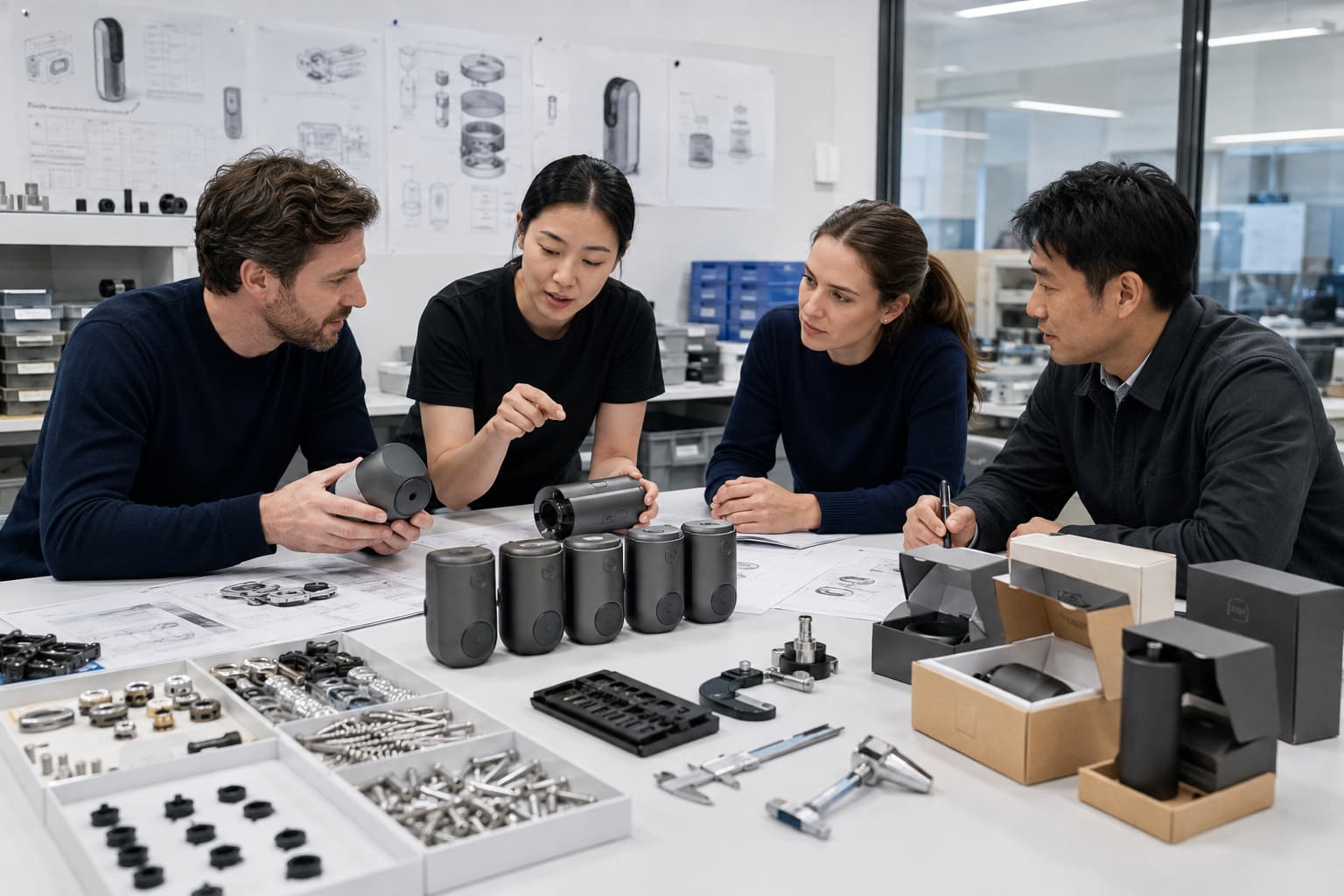
A working prototype is not automatically ready for production. Manufacturing introduces requirements related to repeatability, tooling, tolerances, component availability, assembly sequence, quality control, supplier capability, packaging, and cost.
A full-lifecycle development partner should bring manufacturing considerations into the design process well before final drawings are released. This may include simplifying part geometry, reducing fasteners, clarifying tolerances, selecting standard components, improving assembly access, and designing features that support inspection.
The manufacturing preparation package may include:
- Production-ready CAD and engineering drawings
- Bills of materials and approved component selections
- Electrical schematics and board production files
- Firmware or software release documentation
- Assembly instructions and process requirements
- Quality criteria and inspection procedures
- Supplier quotations and sourcing recommendations
- Tooling plans and production cost estimates
- Packaging specifications
- Regulatory and certification plans
The goal is to transfer design intent without forcing suppliers to guess. Every unresolved assumption becomes a potential source of delay, variation, or cost during production.
Stage 7: Use Pilot Production to Validate the System
Pilot production is the bridge between development and repeatable manufacturing. It tests more than the product itself. It tests the suppliers, tooling, assembly process, documentation, inspection methods, packaging, and communication between everyone involved.
A pilot build may reveal that a part is difficult to assemble, an inspection step is unclear, a supplier interpretation differs from the design intent, or a component lead time creates a schedule risk.
The development company should help the team document those findings, assign ownership, implement corrections, and determine whether another controlled build is necessary.
Moving directly from a successful prototype to a large production order can hide these problems until they affect hundreds or thousands of units.
Stage 8: Support Launch and Early Market Learning
Launch is not simply the date inventory becomes available. It is the point at which the complete product system meets the market.
The team may need to coordinate production ramp-up, packaging, fulfillment, installation, onboarding, customer support, warranty processes, replacement parts, field feedback, and future product updates.
The product development company may not own every commercial activity, but it should help connect technical decisions to the launch plan. It should also make sure early field information reaches the people responsible for engineering and manufacturing improvements.
This continuing connection is part of product realization. The goal is not merely to complete a design. It is to create a viable product and an operating system capable of delivering it.
Why One Accountable Partner Can Reduce Development Risk
Using one full-lifecycle partner does not mean that one organization must perform every specialized task internally. Testing laboratories, toolmakers, contract manufacturers, certification consultants, and other experts may still participate.
The advantage is coordinated ownership.
Without clear ownership, one vendor may optimize a component without understanding how it affects another system. A design team may produce files that do not match a manufacturer’s capabilities. A manufacturer may make changes that alter performance or user experience. Important knowledge can be lost at every handoff.
A strong development company maintains the product requirements, design rationale, risk register, decision history, technical documentation, and commercial objectives across those handoffs. Specialists can contribute without fragmenting the product strategy.
What You Should Receive at Major Development Milestones
A professional engagement should produce more than meetings, attractive renderings, or a physical prototype. The team should receive documented decisions and deliverables appropriate to each stage.
Milestone outputs may include:
- A validated opportunity statement and target user definition
- A prioritized product requirements document
- Concept alternatives and selection rationale
- A technical architecture and development risk assessment
- Prototype plans, test procedures, and results
- Design review records and revision history
- Production documentation and supplier packages
- Pilot build findings and corrective actions
- A manufacturing release decision
- A launch support and post-launch improvement plan
These deliverables create continuity. They also give the client visibility into progress and provide a durable foundation if team members, suppliers, or priorities change.
Questions to Ask a New Product Development Company
Before choosing a partner, ask questions that reveal how the company thinks and how it manages responsibility:
- How do you validate the customer and commercial assumptions behind a product?
- How do you identify and prioritize technical risk?
- Which disciplines will be involved, and who coordinates them?
- How are requirements, decisions, and design changes documented?
- How do you determine what each prototype should test?
- When do manufacturing partners become involved?
- How do you manage sourcing, tooling, and pilot production?
- What deliverables and decision gates should we expect?
- Who owns the designs, files, code, tooling, and documentation?
- How do you support production issues and post-launch improvements?
A long list of services does not automatically indicate full-lifecycle capability. Look for evidence that the company understands the relationships between customer needs, engineering decisions, manufacturing constraints, and commercial outcomes.
Our comparison of a product design company and a full product development partner provides additional guidance for evaluating the scope of an engagement.
When Full-Lifecycle Support Makes Sense
A new product development company is especially valuable when:
- The product crosses multiple technical disciplines
- The requirements are still evolving
- The team has important knowledge but lacks complete development capacity
- Manufacturing decisions will strongly affect performance or cost
- The product has meaningful technical, regulatory, or supply chain risk
- Existing vendors are creating fragmented handoffs
- The company needs one accountable path from concept through launch
Full-lifecycle support may be unnecessary when the design is fully documented and the only remaining need is a specialized supplier or a clearly defined production service. The right engagement model depends on what is known, what remains uncertain, and who is prepared to own the decisions between stages.
From an Idea to a Product System
The best new product development companies do more than complete tasks. They help teams make better decisions in the right sequence.
They connect the customer opportunity to product requirements, requirements to engineering, engineering to prototypes, prototypes to evidence, evidence to manufacturing, and manufacturing to a viable launch.
Ahdept works with founders and product teams to build that connected path. Our venture studio combines product strategy, design, engineering, prototyping, manufacturing preparation, and commercialization support around the needs of each physical product.
The result is not simply a finished prototype. It is a clearer, more defensible route from concept to market.
Need a Clearer Path From Concept to Launch?
Tell us what you are building, where the project stands, and what is preventing it from moving forward. Ahdept can help define the right next stage and assemble the capabilities needed to reach it.
Our Office
450 N. Flint Street
Kaysville, UT 84037, USA
Contact Us
(385) 566-1877
info@ahdept.com
Careers
Office Hours
Mon-Fri: 8am - 5pm
Sat-Sun: Closed