
What Product Realization Means, and Why It Matters
Product realization is the coordinated process of turning a defined product opportunity into a verified, manufacturable, and market-ready physical product. It connects the work of engineering, prototyping, sourcing, production, launch, and commercial execution.
Many physical product ideas reach a working prototype but never become sustainable products. The prototype may demonstrate the central function, yet the team still lacks production documentation, qualified suppliers, realistic unit economics, packaging, inventory planning, or a practical path to market.
This gap exists because creating a prototype and realizing a product are different achievements.
A prototype answers important technical and user questions. Product realization takes those answers and builds the complete system required to manufacture, deliver, and support the product.
What Does Product Realization Mean?
In practical physical product development, product realization includes the work required to implement a design, integrate its components, verify that it meets its specifications, validate that it meets user needs, and transition it into manufacturing and use.
The term also has a formal place in systems engineering. The NASA Systems Engineering Handbook describes product realization through implementation, integration, verification, validation, and transition. In straightforward language, the product must be built correctly, proven against its requirements, confirmed against stakeholder expectations, and moved successfully into its next operating stage.
For a commercial physical product, that next stage extends beyond a technical handoff. The product must also be manufacturable at the intended cost, supported by suppliers, packaged appropriately, distributed reliably, and positioned for customers.
The NIST Manufacturing Extension Partnership similarly connects product development with market validation, prototyping, manufacturing, distribution, and product launch.
Product realization brings these technical and commercial responsibilities together instead of treating them as unrelated projects.
Product Realization Connects
- Market need and product requirements
- Industrial design and engineering
- Prototypes and verified performance
- Design decisions and manufacturing processes
- Suppliers and controlled specifications
- Production cost and commercial pricing
- Inventory and customer demand
- Product launch and continued improvement
Product Development and Product Realization Are Related, but Not Identical
Product development is the broad process of creating and improving a product. It may include market research, concept development, industrial design, engineering, prototypes, testing, and production preparation.
Product realization emphasizes the disciplined transition from a proposed solution into something that can be repeatedly built, delivered, and supported.
The distinction matters because teams can complete substantial development work without establishing a viable path to production or market. A product may have attractive industrial design, functioning electronics, and a convincing prototype while still being too expensive, difficult to assemble, impossible to source, or unsupported by a launch plan.
The broader responsibilities of a development partner are explained in What Does a Product Development Company Actually Do? Product realization is the point where those responsibilities must converge around a finished commercial outcome.
A Prototype Is Evidence, Not the Finish Line
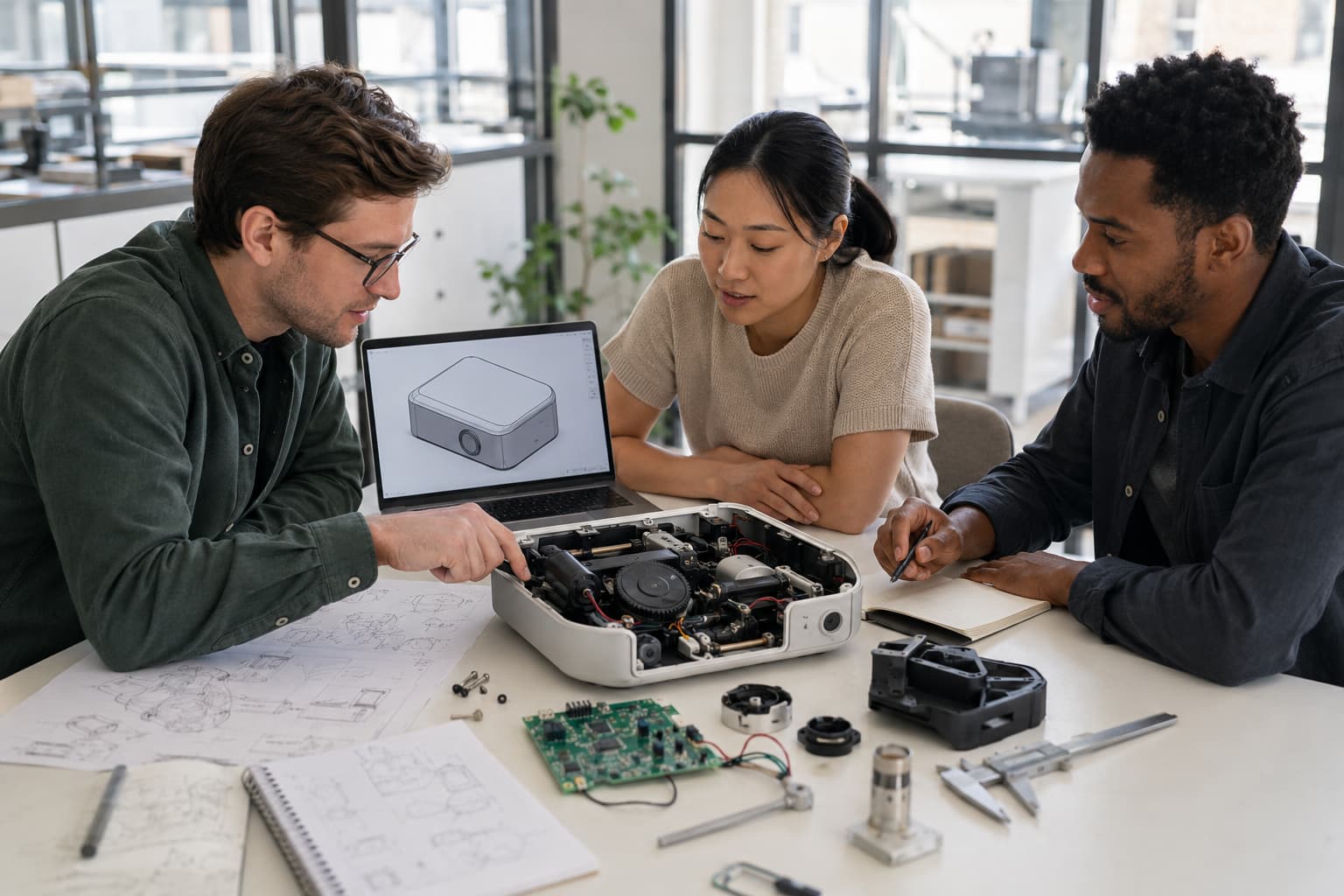
A strong prototype can prove that a mechanism works, a user can operate the product, or an electronic system can perform its intended function. It can also expose problems in fit, durability, usability, material selection, and component integration.
However, prototypes are often built through methods that do not represent volume production. Parts may be individually printed, machined, hand-finished, or assembled by the engineers who designed them. Development boards may stand in for custom electronics. Components may be sourced individually without confirming volume availability.
Those shortcuts are appropriate when the prototype’s purpose is learning. They become a problem when the team assumes the same prototype can move directly into manufacturing.
Product realization asks a different set of questions:
- Can the product be produced consistently?
- Are materials and components available at the required volume?
- Can normal production workers assemble it efficiently?
- Are tolerances measurable and achievable?
- Can finished units be inspected against objective standards?
- Does the unit cost support the intended selling price?
- Can the product be packaged, shipped, serviced, and supported?
- Is the organization ready to respond after customers begin using it?
Product realization does not replace prototyping. It uses prototype evidence to determine what must be refined, documented, sourced, and controlled before the product advances.
Start With a Defined Product Opportunity
Product realization begins before detailed engineering. The team needs a clear understanding of the customer problem, intended user, use environment, competing alternatives, target price, and reason the product should exist.
Without that foundation, engineering teams can successfully build a product that lacks a strong commercial role.
The product opportunity should be translated into measurable requirements. These may cover dimensions, performance, durability, battery life, materials, environmental exposure, expected service life, target manufacturing cost, and user interaction.
Requirements create a connection between the market opportunity and the technical design. When engineering tradeoffs become necessary, the team can evaluate them against the product’s intended value instead of making decisions based only on preference.
Coordinate Design and Engineering Around the Complete Product
Physical products rarely belong to a single discipline. Industrial design affects component space and manufacturing geometry. Mechanical design affects circuit-board placement and antenna performance. Material selection affects durability, appearance, tooling, and cost.
Product realization requires these decisions to be managed as one connected system.
This coordination may involve:
- Product and technical requirements
- Industrial and ergonomic design
- Mechanical engineering
- Electrical engineering
- Embedded firmware
- Material and component selection
- Prototype development
- Testing and validation
- Manufacturing process planning
The specific technical disciplines and deliverables involved are covered in What Product Engineering Services Include, and When You Need Them.
When these disciplines operate separately, integration problems tend to appear late. When they work from shared requirements and coordinated design reviews, the team can identify conflicts while practical options remain available.
Verify the Product and Validate the Opportunity
Verification and validation answer two different questions.
Verification asks whether the product was built to its specifications. If the requirement calls for a specific load capacity, battery life, dimensional tolerance, or sensor accuracy, verification tests whether the product achieves it.
Validation asks whether the resulting product satisfies the intended user and use case. A product can meet every written specification and still fail to solve the customer’s problem effectively.
Both are necessary. Verification without validation can produce a technically correct product that customers do not value. Validation without verification can create strong early interest in a product that cannot perform reliably.
Product realization connects user feedback, engineering tests, and commercial expectations. The findings should lead to documented decisions rather than informal opinions.
Design the Product for Production
A prototype may be built by highly skilled engineers using custom methods and significant hands-on adjustment. Production needs repeatable parts, controlled processes, clear instructions, and measurable acceptance criteria.
Preparing the design for production may include:
- Reducing unnecessary part count
- Selecting production materials
- Adjusting geometry for tooling and fabrication
- Defining achievable tolerances
- Improving fastener and assembly access
- Standardizing hardware and purchased components
- Creating fixtures, gauges, or test procedures
- Establishing quality-control checkpoints
- Documenting approved substitutions
The goal is not simply to make the product cheaper. It is to create a production system that preserves the function and experience customers expect.
Build the Manufacturing Package
Product realization converts engineering knowledge into documentation that can move beyond the original development team.
A manufacturing package may include:
- Released CAD files and engineering drawings
- A controlled bill of materials
- Material and finish specifications
- Approved parts and suppliers
- Assembly instructions
- Firmware and programming requirements
- Inspection criteria
- Functional test procedures
- Packaging and labeling specifications
- Revision and change-control records
This package gives manufacturers, suppliers, quality teams, and internal stakeholders a common definition of the product.
Without controlled documentation, important knowledge remains in emails, meetings, individual CAD files, or the memory of a few team members. That makes the product difficult to reproduce and risky to transfer.
Connect Suppliers to the Product Requirements
Supplier selection is not only a purchasing decision. A low quote has limited value if the supplier cannot maintain quality, source materials, meet lead times, protect tooling, or communicate clearly when problems arise.
Product realization evaluates suppliers against the actual product requirements. The team should understand process capabilities, tooling needs, minimum orders, production capacity, lead times, inspection methods, payment terms, and ownership of manufacturing assets.
Supplier feedback may also improve the design. Manufacturers can identify features that are difficult to produce, tolerances that create unnecessary cost, or components with unstable availability.
Those recommendations should be reviewed by the engineering team before they are accepted. A manufacturing change that reduces cost may also affect performance, durability, appearance, or compliance.
Prove the Production Process

A pilot build tests whether the production system can create acceptable products under realistic conditions. It evaluates more than the design itself.
The team can observe whether:
- Parts arrive within specification
- Assembly instructions are clear
- Tools and fixtures work correctly
- Production steps occur in a practical sequence
- Functional testing catches meaningful problems
- Inspection standards are interpreted consistently
- Packaging protects the product during handling and shipping
- Labor and cycle-time assumptions are realistic
Problems discovered in pilot production should be corrected before volume increases. This may require changes to the product, documentation, tooling, supplier process, assembly method, or quality plan.
The transition from a validated prototype into this production system is discussed further in From Idea to Market, Stage 4: Preparing for Manufacturing and Launch.
Commercial Readiness Is Part of Product Realization
Producing a physical product does not automatically create a business. Inventory still needs to be priced, packaged, marketed, sold, shipped, supported, and replenished.
Commercial readiness may include:
- Final unit economics and pricing
- Sales forecasts and initial order quantities
- Packaging and fulfillment planning
- Product instructions and support materials
- Warranty and return procedures
- Sales and marketing assets
- Distribution and channel preparation
- Inventory and replenishment systems
- A process for collecting customer feedback
These decisions should influence product realization before manufacturing commitments are final. Packaging affects product dimensions and shipping cost. Warranty expectations influence durability targets. Channel margins affect allowable manufacturing cost. Launch timing affects inventory and supplier schedules.
A product is not fully realized if its technical design and commercial model contradict one another.
Product Realization Prevents Ownership Gaps
Physical product projects often involve separate designers, engineers, prototype shops, manufacturers, marketers, and business leaders. Each group may perform its assigned task correctly while critical responsibilities remain unowned between them.
A designer may provide a visual concept but not production geometry. An engineer may produce CAD but not qualify suppliers. A prototype shop may deliver parts without documenting how the results affect manufacturing. A contract manufacturer may build exactly what it receives without challenging the underlying product strategy.
Product realization creates continuity across those handoffs. Someone must maintain the complete view of the product, requirements, risks, cost, manufacturing process, user experience, and commercial objective.
That ownership is one of the practical advantages of a venture studio model. The same partner can remain involved across technical development, manufacturing preparation, and commercialization instead of handing the product off at the edge of a narrow service agreement.
When Do You Need Product Realization Support?
Product realization support may be useful when:
- You have a promising concept but no complete path to manufacturing.
- Your prototype works, but the design is not production-ready.
- Engineering, sourcing, manufacturing, and launch teams are disconnected.
- No one owns the complete product outcome.
- Suppliers are requesting technical documentation you do not have.
- Your estimated production cost does not support the business model.
- The project repeatedly stalls at handoffs between vendors.
- Your internal team lacks manufacturing or commercialization experience.
- You need a partner who can stay involved from prototype through launch.
Support can begin with an early concept or an existing prototype. The first step should be an honest assessment of what has already been proven, which assumptions remain unresolved, and what is required to reach the next meaningful milestone.
Product Realization Turns Progress Into an Outcome
Physical product development creates many visible signs of progress: sketches, CAD models, prototypes, test reports, supplier quotes, and packaging concepts. Each is useful, but none alone represents a completed product.
Product realization coordinates those pieces around a commercial outcome. The product must satisfy users, meet technical requirements, work with manufacturing processes, support viable economics, and reach the market through a prepared organization.
That is why product realization matters. It closes the gap between proving that an idea can work and building the complete system required to make it available to customers.
Move Your Product From Prototype to Market
Ahdept helps founders and product teams coordinate engineering, prototyping, sourcing, manufacturing preparation, and commercialization around one complete product outcome.
Our Office
450 N. Flint Street
Kaysville, UT 84037, USA
Contact Us
(385) 566-1877
info@ahdept.com
Careers
Office Hours
Mon-Fri: 8am - 5pm
Sat-Sun: Closed