Physical Product Development, What Founders Usually Underestimate
Physical product development turns a promising idea into something that must work in the real world, survive repeated use, and be manufactured consistently. Founders rarely underestimate the importance of the idea. They often underestimate the interconnected decisions, dependencies, costs, and evidence required to make it real.
A physical product can appear simple from the outside while containing dozens of connected decisions. Its size affects its internal layout. Its layout affects its electronics, thermal behavior, assembly, and serviceability. Its materials affect appearance, performance, tooling, unit cost, and durability.
A decision that looks isolated may affect the entire product system.
This is why physical product development rarely moves directly from sketch to prototype to production. The process involves learning, testing, revising, sourcing, documenting, and validating. Each stage should reduce a different category of risk before the team makes a larger commitment.
Founders do not need to become experts in every engineering or manufacturing discipline. They do need a realistic understanding of what the development process must accomplish.
1. An Idea Is Not Yet a Product Definition
Founders often begin with a clear picture of the product in their minds. They understand the customer problem, the basic function, and perhaps what the product should look like.
That vision is valuable, but it is not yet a complete definition.
A development team still needs to determine:
- Who the primary user is
- What environment the product must operate in
- Which functions are essential
- Which features are optional
- What performance level customers actually need
- What price and manufacturing cost may be viable
- What safety, regulatory, or certification requirements apply
- How the product will be assembled, shipped, used, serviced, and retired
If these questions remain vague, designers and engineers must make assumptions. Those assumptions can become embedded in the product before the founder realizes a decision was made.
The goal of early discovery is not to remove all uncertainty. It is to identify the most consequential assumptions and decide how they will be tested.
Our guide to validating a product idea before building explains how founders can reduce customer and market uncertainty before engineering costs accelerate.
2. The Timeline Is More Than Design Time
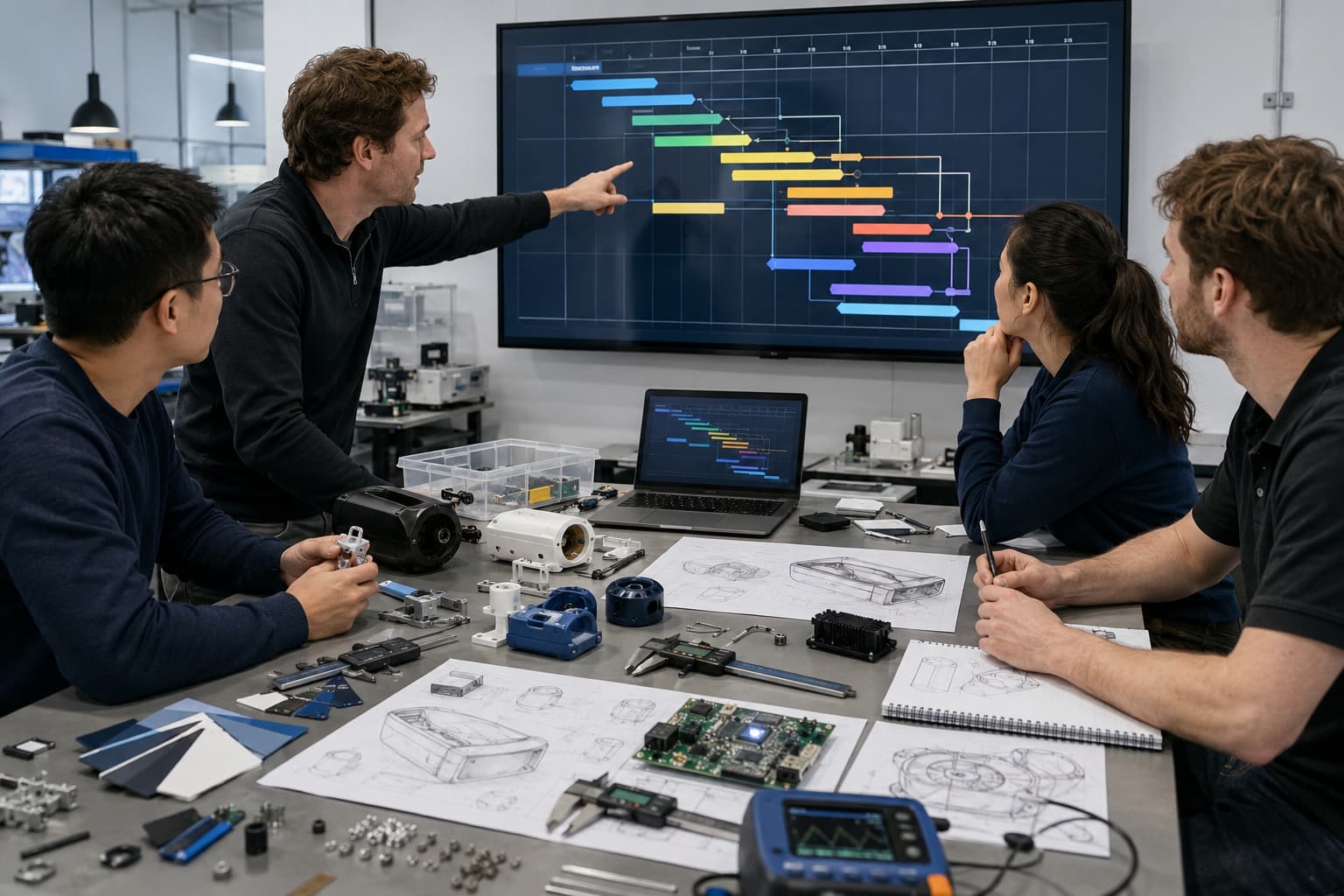
Founders frequently estimate the schedule based on how long they believe the design work should take. The actual schedule also includes decisions, purchasing, fabrication, shipping, assembly, testing, analysis, revisions, and additional builds.
A prototype may take two weeks to fabricate, but the team first needs to complete the design, prepare files, request quotations, select a supplier, order components, and confirm availability. Once the parts arrive, they must be inspected, assembled, tested, and evaluated.
If the test reveals a problem, the cycle begins again.
Hardware schedules also contain dependencies. An enclosure design may depend on the selected battery. The circuit board may depend on the enclosure layout. Firmware integration may depend on the circuit board. Environmental testing may depend on having a sufficiently representative enclosure and assembly.
Several activities can happen in parallel, but not every dependency can be compressed.
A realistic schedule should include:
- Decision and approval time
- Component and material lead times
- Supplier quotation and onboarding time
- Prototype fabrication and shipping
- Assembly and integration
- Testing and failure analysis
- Design revisions
- Additional prototype builds
- Tooling development
- Certification or laboratory testing
- Pilot production
- Corrective actions before launch
The purpose of schedule contingency is not to excuse poor planning. It is to acknowledge that physical development generates new information, and some of that information will require action.
3. One Prototype Will Not Answer Every Question
A prototype is often discussed as if it were a single milestone: build the prototype, prove the product, and proceed to manufacturing.
Different prototypes answer different questions.
A rough proof of concept might evaluate a mechanism. A breadboard may test electronics or sensors. An appearance model may evaluate size, proportions, and user interaction. An integrated engineering prototype may combine mechanical, electrical, and firmware systems. A production-intent prototype may evaluate materials, assembly, tolerances, and manufacturing processes.
No single prototype automatically proves:
- Customers will buy the product
- The product will survive long-term use
- The design meets every requirement
- Suppliers can manufacture it consistently
- The target cost is achievable
- The assembly process is efficient
- The product will pass regulatory testing
Before building a prototype, founders should ask what the team needs to learn and what decision will follow the test.
Our article on rapid prototyping services explains how prototype type, fidelity, and process should match the specific question being investigated.
A prototype is not progress merely because it exists. Its value comes from the evidence it produces and the decisions that evidence supports.
4. Small Changes Can Have Large Consequences
Founders often assume that a seemingly minor design change should be easy to make. Sometimes it is. Other times, the change affects several connected systems.
Increasing battery capacity may change the internal layout, weight, charging time, thermal behavior, enclosure size, shipping classification, and cost. Moving a button may affect the circuit board, wiring, sealing, tooling, user instructions, and test fixtures.
Changing a material may affect strength, flexibility, appearance, chemical resistance, supplier availability, manufacturing process, and recyclability.
The visible change may be small while the technical consequences are not.
This does not mean founders should avoid improvements. It means changes should be evaluated as system decisions. The team should determine which files, components, tests, suppliers, tools, and requirements may be affected before approving the change.
5. Sourcing Is Part of the Design
Sourcing is sometimes treated as a purchasing activity that begins after engineering is complete. In physical product development, sourcing decisions can determine whether the design is practical.
A component may meet the technical requirements but have an unacceptable lead time, high minimum order quantity, limited supplier base, short lifecycle, or unpredictable availability. A manufacturing process may produce the desired geometry but require tooling or production volumes that do not fit the launch plan.
The NIST Manufacturing Extension Partnership recommends supply chain mapping, supplier assessment, alternative sources, and risk planning as tools for improving supply chain performance and resilience.
Founders should ask:
- Is the component available from more than one supplier?
- Is it appropriate for the expected product life?
- What is the minimum order quantity?
- How stable is the lead time?
- Does the supplier support the required production volume?
- Is there a practical substitute if availability changes?
- Will replacing it require new testing or certification?
- Who owns the relationship and monitors future changes?
A product designed around unavailable or commercially impractical parts is not production-ready, regardless of how well the prototype performs.
6. The Quoted Unit Price Is Not the True Product Cost
Founders naturally focus on unit cost. It is an important number, but a factory quotation may not represent the complete cost of putting the product into a customer’s hands.
Other costs may include:
- Tooling and fixtures
- Engineering and setup charges
- Minimum order quantities
- Freight, tariffs, and insurance
- Packaging and labeling
- Warehousing and fulfillment
- Quality inspection
- Certification and compliance testing
- Scrap, rework, and production yield loss
- Returns, warranty replacements, and customer support
- Spare parts and service inventory
Payment timing matters too. Suppliers may require deposits long before finished units can be sold. Inventory can consume cash while the company is also funding packaging, marketing, distribution, and customer support.
A viable product needs a cost model that connects manufacturing assumptions to pricing, margin, channel strategy, volume, and cash requirements.
7. Manufacturability Does Not Appear Automatically
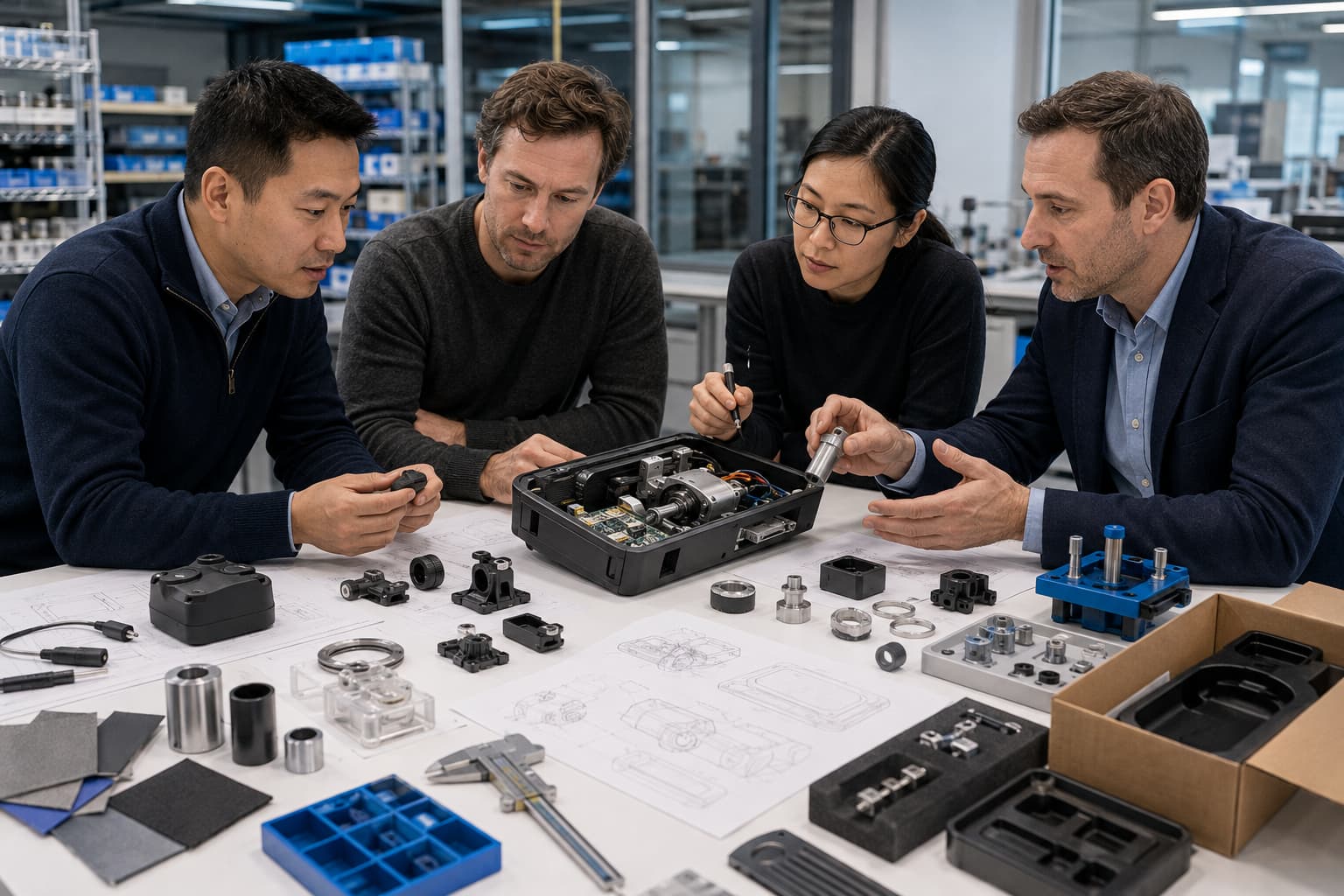
A prototype process is selected to build a small number of units quickly and learn efficiently. A production process is selected to build units repeatedly at the required quality, cost, and volume.
Those goals are different.
A 3D-printed enclosure may work well for testing but behave differently from an injection-molded enclosure. A hand-wired prototype may prove the electrical architecture but reveal little about production assembly time. Machined parts may achieve geometry that would be expensive or impractical to mold.
Manufacturability requires deliberate engineering. The team may need to simplify geometry, reduce part count, adjust tolerances, select different materials, add assembly features, improve inspection access, or redesign components around a scalable process.
Manufacturing partners should be involved early enough to influence the design, not only after the team believes it is finished.
Our guide to design for manufacturing explains how product and production requirements are brought together before tooling and volume commitments are made.
8. Testing Requires More Than Demonstrating That It Works
A successful demonstration usually proves that one unit worked under a particular set of conditions. It does not automatically establish reliability, durability, safety, or production consistency.
A meaningful test plan should connect directly to the product requirements and expected use conditions.
Depending on the product, testing may address:
- Functional accuracy
- Repeated operation
- Drop and impact resistance
- Temperature and humidity
- Water and dust exposure
- Battery life and charging
- Wireless communication
- Mechanical loads
- Material compatibility
- Packaging and shipping
- Usability and foreseeable misuse
Regulatory and certification requirements can also affect design decisions, component selection, schedule, and cost. They should be investigated early enough to influence the development plan.
Testing is not simply a final exam. Early testing helps the team identify weak assumptions while changes remain relatively manageable.
9. Production Documentation Is a Product Deliverable
Founders often focus on the physical prototype and overlook the documentation required to reproduce it.
A manufacturer cannot consistently build the intended product from verbal instructions, scattered emails, and the latest CAD file on someone’s computer.
The production package may require:
- Controlled CAD files and drawings
- Dimensions and tolerances
- Bills of materials
- Approved components and suppliers
- Electrical schematics and board files
- Firmware and software release versions
- Assembly instructions
- Test procedures
- Inspection standards
- Packaging specifications
- Revision history
This documentation communicates design intent and controls which version is being built. It also reduces dependence on the memory of individual team members.
Founders should clarify who owns the design files, source code, tooling, test fixtures, supplier information, and production documentation. Ownership should be understood before important work begins, not after a relationship ends.
10. A Working Prototype Is Not Ready for Scale
A functioning prototype is an important achievement. It proves that the project has moved beyond theory. It does not prove that the product is ready for a large purchase order.
Before scaling, the team still needs to determine whether:
- The design satisfies the critical requirements
- The materials and components represent production intent
- Suppliers can meet the required quality and volume
- Tooling produces acceptable parts
- Assembly instructions are clear
- Inspection and test methods detect important defects
- Production yield is acceptable
- Packaging protects the product
- Field support and warranty processes are ready
A controlled pilot build allows the team to test the production system before committing to greater quantities. Problems may still appear, but they affect a manageable number of units and can be investigated before full production.
The transition is covered in more detail in Prototype to Manufacturing, What Has to Happen Before You Scale?
11. Launch Requires Capital Beyond Development
Founders may raise or allocate enough money to complete the design without reserving enough capital to manufacture and launch it.
Production may require deposits for tooling, components, packaging, and inventory. The company may need to pay those costs before it receives revenue from customers or distributors.
The launch budget may also need to support:
- Final testing and certification
- Tooling adjustments
- Pilot production
- Initial inventory
- Packaging and freight
- Warehousing and fulfillment
- Marketing and channel development
- Customer onboarding and support
- Warranty replacements
- Post-launch engineering changes
A product can be technically successful and still create financial stress if cash requirements, payment terms, inventory, and production timing were not modeled early.
12. Every Important Decision Needs an Owner
Physical product development often involves founders, designers, engineers, prototype suppliers, testing laboratories, component vendors, manufacturers, and commercial partners.
Specialists are valuable, but they can also create fragmented responsibility.
A manufacturer may assume the engineering team approved a tolerance. The engineering team may assume the supplier will select an equivalent material. The founder may assume someone is monitoring component availability. Each participant can complete an assigned task while an important system-level decision remains unowned.
The project needs clear accountability for requirements, interfaces, changes, testing, sourcing, documentation, and production approval.
Founders evaluating outside support can use our guide to how a new product development company guides products from concept to launch to understand what full-lifecycle coordination should include.
How Founders Can Plan More Realistically
The answer is not to predict every problem before development begins. That is impossible. The goal is to create a process that exposes the right problems before they become expensive commitments.
Founders can improve the development plan by:
- Defining customer, technical, and commercial assumptions separately
- Turning important needs into measurable requirements
- Testing high-risk questions before polishing the complete product
- Giving every prototype a specific learning objective
- Including supplier and fabrication lead times in the schedule
- Involving manufacturing expertise before the design is frozen
- Evaluating total product cost instead of unit price alone
- Planning verification, certification, and pilot production early
- Maintaining controlled technical documentation
- Reserving capital and schedule for launch corrections
- Assigning one owner to every major decision and interface
A good development plan does not promise that nothing will go wrong. It creates a disciplined way to discover, understand, and correct problems while the team still has reasonable options.
Physical Product Development Rewards Clear Thinking
Founders usually understand that physical products require engineering. What they often underestimate is how closely engineering is connected to sourcing, manufacturing, testing, documentation, cost, and commercialization.
The product is not complete when it looks right or works once. It must satisfy a real customer need, perform under expected conditions, and move through a production system capable of building it consistently.
Ahdept helps founders manage those connections. Our venture studio combines product strategy, design, engineering, prototyping, manufacturing preparation, and commercialization around one coordinated path from early concept to market.
The goal is not to eliminate every surprise. It is to prevent avoidable surprises from consuming the schedule, capital, and momentum required to launch.
Planning a Physical Product?
Tell us what you are building, what has already been validated, and which development questions remain unresolved. Ahdept can help create a realistic path through engineering, sourcing, manufacturing, and launch.
Our Office
450 N. Flint Street
Kaysville, UT 84037, USA
Contact Us
(385) 566-1877
info@ahdept.com
Careers
Office Hours
Mon-Fri: 8am - 5pm
Sat-Sun: Closed