Provisional vs. Nonprovisional Patent Applications for Physical Products
 For physical product founders, the difference between a provisional and a nonprovisional patent application is not just paperwork. It affects timing, cost, strategy, and what kind of protection path you are actually starting. A lot of founders assume a provisional application is a cheaper patent, or that filing one automatically handles the hard part. It does not.
A better way to think about it is this: a provisional application can be a useful early step when the invention needs a filing date and the founder needs time to keep developing the product. A nonprovisional application is the formal application that actually moves into examination.
This is not legal advice, and it should not replace a conversation with a qualified patent attorney or patent agent. It is a practical guide to help physical product founders understand what each path generally does and does not do before spending money blindly.
What a Provisional Application Actually Does
A provisional application is often used when a founder wants to establish an earlier filing date while buying time to refine the invention, improve the product, or prepare for a fuller filing later. For physical products, that can matter because the product may still be evolving through prototyping, testing, and early engineering decisions.
What a provisional application does well is create a starting point. It can give the founder a way to document the invention at that stage and preserve an earlier filing date if a corresponding nonprovisional application is filed properly and on time.
What it does not do is become a patent by itself. It also does not mean the application has been examined, approved, or confirmed as patentable. Founders sometimes confuse “filed” with “protected” in the strongest sense. That is one of the most common misunderstandings in early patent strategy.
What Founders Often Like About a Provisional Filing
- It can be a lower-cost starting point than a full nonprovisional filing.
- It can help establish an earlier filing date.
- It can buy time while the product is still being refined.
- It can fit situations where the invention is real, but the product is still evolving.
What a Nonprovisional Application Actually Does
A nonprovisional patent application is the formal application that goes into examination. This is the filing path that can eventually mature into an issued patent if the application clears the legal requirements.
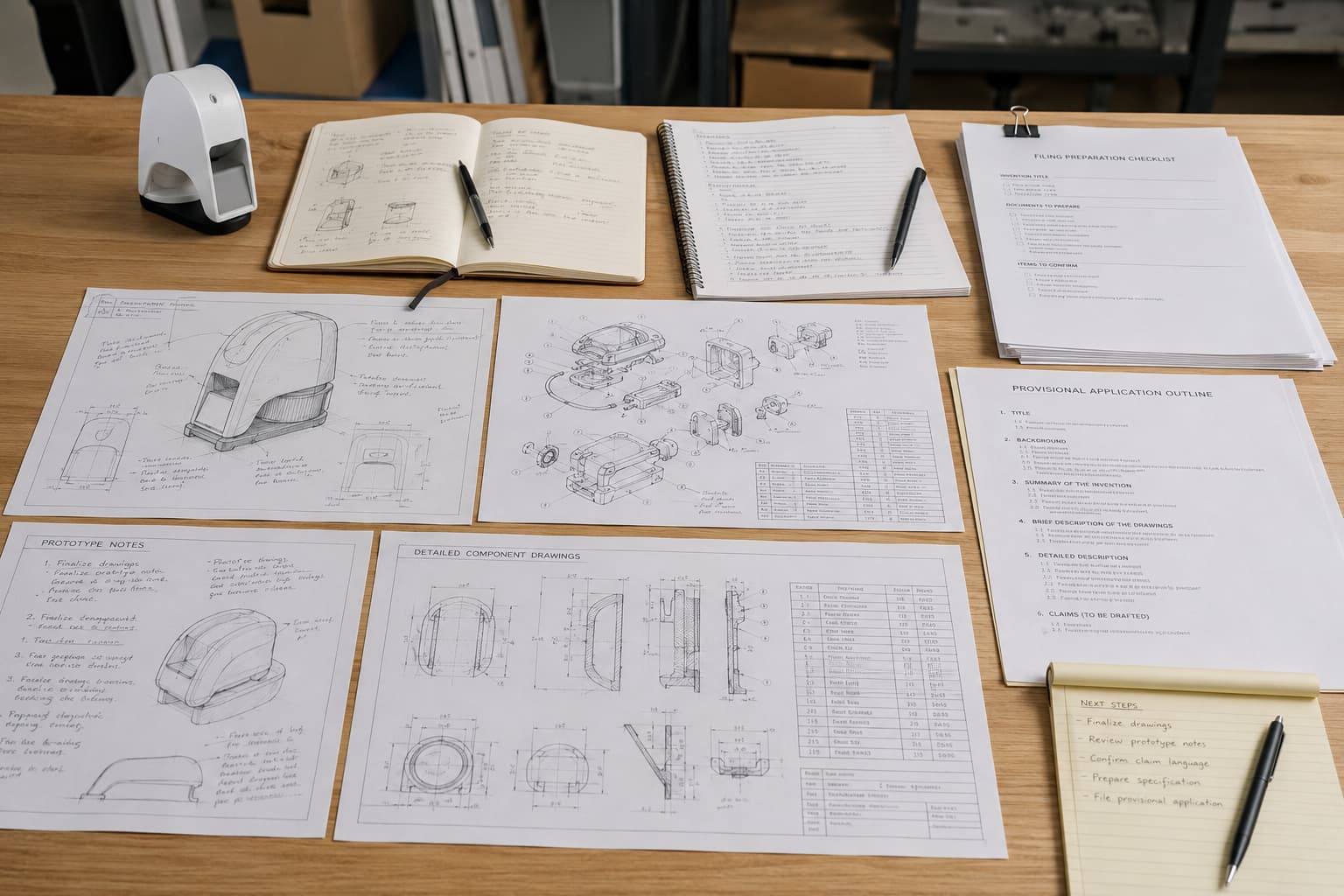 For a physical product founder, this usually means the invention needs to be described at a level that can support a serious filing strategy. That tends to require clearer definition, better drawings or figures, more disciplined invention thinking, and stronger coordination with counsel.
The nonprovisional application is where the stakes become more concrete. It is not just about staking a place in line. It is about putting forward the application that will actually be reviewed and challenged through the patent process.
That is why a nonprovisional application usually demands more preparation. For physical products, the founder should be much clearer on what the invention is, what parts of the product may actually be inventive, and how the current product development stage connects to the filing strategy.
Why This Difference Matters So Much for Physical Products
For software founders, product changes can happen quickly and invisibly. Physical products tend to make the timing question harder because changes to structure, materials, assemblies, features, and manufacturability can all affect how the invention should be described and protected.
That does not mean physical product founders should delay forever. It means they should be more deliberate about where the product stands when they file. If the product is still moving rapidly, a provisional filing may sometimes make more sense as a strategic placeholder. If the invention is much more defined and the founder is ready for formal prosecution, the nonprovisional path may be the more logical step.
What matters is not choosing the cheaper sounding label. What matters is understanding what stage the product is actually in, and what you need the filing to accomplish.
Questions Founders Should Ask Before Choosing a Path
- Is the invention defined clearly enough for a serious formal filing?
- Is the product still changing in ways that may affect the invention description?
- Do you need an early filing date now, or do you need a fuller application strategy now?
- Are you filing because the invention is ready, or because you feel pressured to “do something”?
- Have you documented the invention clearly enough to make legal time productive?
What Each Path Does Not Protect You From
Neither path replaces product clarity, business validation, or disciplined documentation. Filing something does not magically solve uncertainty around the market, the product version, or the broader commercialization path.
A provisional filing does not remove the need for follow-through. A nonprovisional filing does not guarantee you will get a patent. And neither one changes the reality that a weakly defined invention or sloppy documentation can make the whole process harder and more expensive.
This is why founders should not treat patent filing like a checkbox. It is part of the product strategy, not a substitute for it.
When a Provisional Filing May Be More Useful
A provisional application may be more useful when the invention is real enough to justify filing, but the product still needs time for refinement, prototyping, testing, or better definition before a fuller application makes sense.
This can happen often with physical products because the path from concept to manufacturable product tends to reveal new details. A founder may know the core inventive idea, but still need time to improve the embodiment, clarify alternatives, or document the invention more thoroughly.
That does not make provisional filings casual. It just means they are often used as part of a staged strategy instead of as the final move.
When a Nonprovisional Filing May Be the Better Move
A nonprovisional application may be the better move when the invention is already well defined, the founder is ready for formal examination, and the product development work has reached a stage where the filing strategy is clearer.
For physical products, that often means the team has a stronger grasp on the product architecture, the inventive distinction, likely variations, and how the invention should be described in a serious application. It may also mean the founder is ready to commit more fully to the legal process rather than just preserving an earlier date.
If the product and invention are already mature enough, going straight to a nonprovisional application can make more sense than using a provisional filing as an extra step.
If you want the broader preparation mindset before spending on IP work, read Patent Filing for Product Startups, What to Do Before You Spend Money. And if your invention is still tied up with open product questions, From Idea to Market, Stage 2, How to Turn Early Concepts Into a Real Product Plan is a useful companion read.
Get Clear Before You Spend on IP
If your physical product is still evolving and you need sharper definition before expensive legal or development decisions pile up, Ahdept can help you think through the product side of that decision more clearly.
FAQ
What is the difference between a provisional and nonprovisional patent application?
A provisional application is often used as an earlier filing step that can preserve a filing date while the founder continues refining the invention. A nonprovisional application is the formal application that is examined and can potentially mature into a patent.
Does a provisional patent application become a patent?
No. A provisional application does not become a patent by itself. It is typically used as a temporary starting point that must be followed properly if the founder wants to pursue patent protection further.
Should physical product founders start with a provisional application?
Sometimes, but not automatically. It depends on how defined the invention is, how much the product is still changing, and what the founder needs the filing to accomplish.
Is a nonprovisional patent application better than a provisional one?
Not in every case. It serves a different role. A nonprovisional filing is the formal application path, while a provisional filing can be useful when the founder needs an earlier filing date and more time for product refinement.
Our Office
450 N. Flint Street
Kaysville, UT 84037, USA
Contact Us
(385) 566-1877
info@ahdept.com
Careers
Office Hours
Mon-Fri: 8am - 5pm
Sat-Sun: Closed