
What Product Engineering Services Include, and When You Need Them
Product engineering services turn a promising physical product concept into a defined, testable, and manufacturable system. They connect requirements, mechanical design, electronics, prototyping, validation, documentation, and production planning.
A product can have a strong market opportunity and still fail technically. Parts may not fit together, materials may perform poorly, electronics may interfere with the enclosure, or the design may become too difficult to manufacture at its target cost.
Product engineering addresses those risks by converting the idea into technical requirements, solving the product’s functional challenges, and producing the documentation needed to build it consistently.
Some companies use product engineering services for a specific technical problem. Others need an outside team to manage the complete engineering workstream. The right level of support depends on what has already been developed, which capabilities exist internally, and what the product must accomplish next.
What Are Product Engineering Services?
Product engineering services cover the technical work required to design, build, test, document, and prepare a physical product for manufacturing. They may involve one engineering discipline or the coordination of several disciplines across the complete product system.
For a simple mechanical product, that work might focus on materials, geometry, tolerances, motion, and manufacturing processes. A connected device may require mechanical engineering, electrical engineering, printed circuit board development, embedded firmware, wireless integration, power management, and system testing.
The NIST Manufacturing Extension Partnership provides product design and development resources that help manufacturers move ideas through prototyping and toward production. This reflects an important reality: engineering does not end when the CAD model is complete. It must connect the design to testing, manufacturing, quality, and commercialization.
Product engineering is one part of the broader work described in What Does a Product Development Company Actually Do? Product development may include research, strategy, industrial design, engineering, sourcing, manufacturing preparation, and launch. Product engineering concentrates on the technical system that makes the product function.
Product Engineering Services May Include
- Technical requirements and product specifications
- Mechanical engineering and CAD development
- Electrical engineering and circuit design
- Embedded firmware and device integration
- Material and component selection
- Engineering analysis and simulation
- Prototype design, fabrication, and testing
- Design for manufacturing and assembly
- Engineering drawings and bills of materials
- Design verification and validation support
- Supplier and manufacturing coordination
- Revision control and production change support
Requirements and System Definition
Engineering should begin with a clear definition of what the product needs to do. Without measurable requirements, teams can make progress on individual components while still moving toward the wrong complete system.
Product requirements may address:
- Physical dimensions and weight
- Loads, forces, and expected service life
- Operating temperature and environmental exposure
- Power consumption and battery life
- Wireless range or communication protocols
- Sensor accuracy and response time
- User controls and status indicators
- Target manufacturing cost
- Assembly and service requirements
- Applicable safety and regulatory constraints
Not every requirement will be known at the start. Product engineering helps the team identify what must be defined, what can remain flexible, and which unknowns require testing.
A requirements document also provides a basis for evaluating the design. Instead of deciding that the prototype “works well,” the team can compare measured performance against agreed criteria.
Mechanical Engineering
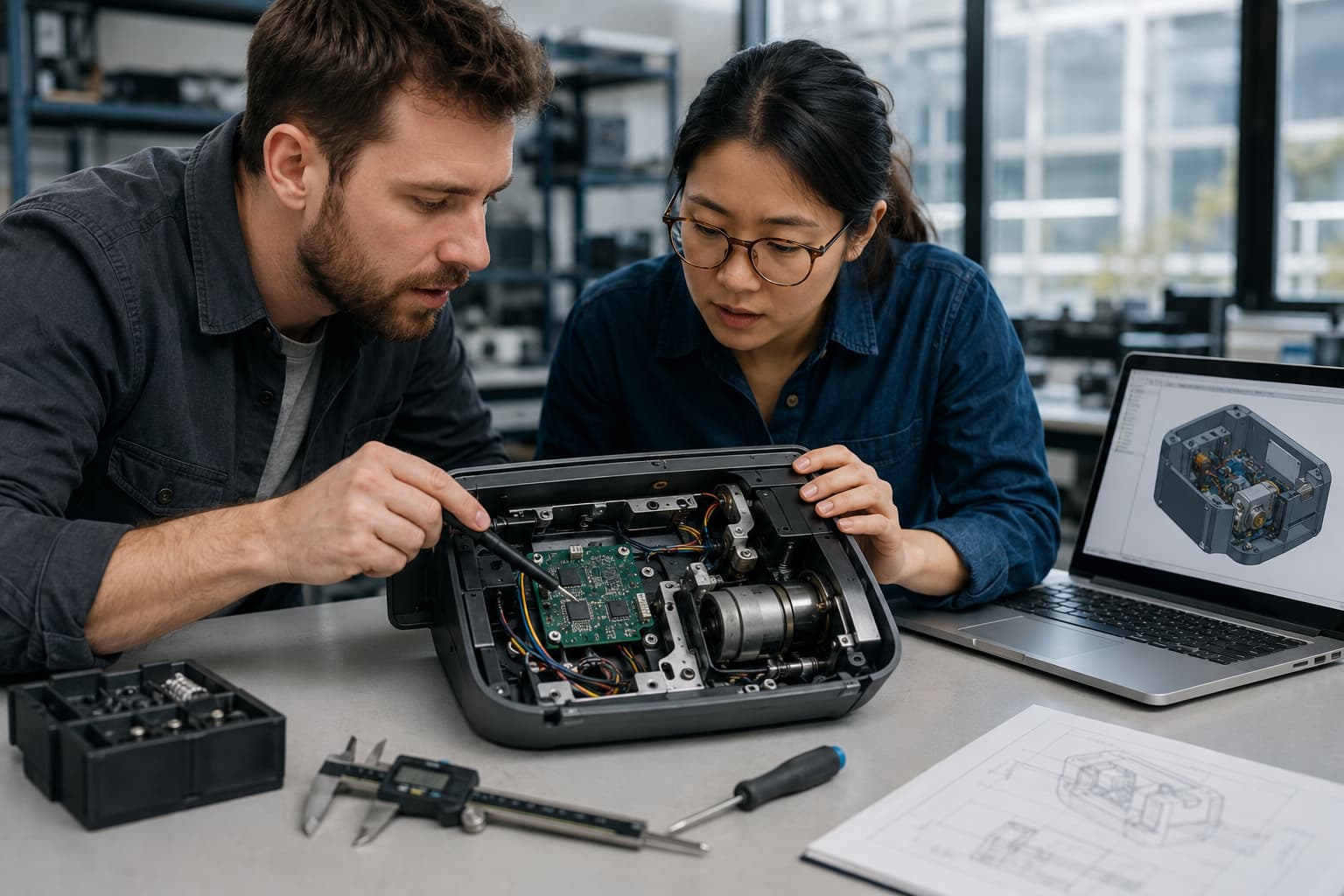
Mechanical engineering defines the physical structure of the product. It determines how parts fit together, move, withstand forces, manage heat, and interact with users and internal components.
Mechanical product engineering may include:
- Three-dimensional CAD modeling
- Part and assembly design
- Mechanism development
- Fastener and joining strategies
- Tolerance and clearance analysis
- Material selection
- Thermal management
- Structural analysis
- Sealing and environmental protection
- Ergonomic and human-factors refinement
Mechanical engineers must consider how each design decision affects the rest of the product. Moving a mounting feature may create more room for a circuit board but make the enclosure harder to mold. Increasing wall thickness may improve stiffness but add weight, material cost, or cooling time during production.
This is why mechanical engineering should remain connected to manufacturing instead of being treated as an isolated CAD exercise.
Electrical Engineering and Embedded Systems
Electronic products require coordinated development of circuits, components, power systems, sensors, controls, communication, and firmware.
Electrical engineering services may include:
- System architecture and component selection
- Schematic design
- Printed circuit board layout
- Power supply and battery design
- Sensor and actuator integration
- Wireless communication design
- Connector and cable selection
- Electromagnetic compatibility planning
- Prototype circuit assembly and bench testing
Embedded firmware controls how the hardware behaves. It may manage sensors, motors, displays, wireless communication, data collection, power states, alerts, and user inputs.
Mechanical, electrical, and firmware teams need to work from a shared system architecture. An enclosure designed without confirmed circuit-board dimensions can create fit problems. A radio placed without considering the housing material may perform poorly. A processor or battery selected too late may affect heat, runtime, cost, and available internal space.
Integrated product engineering identifies these dependencies before they become expensive redesigns.
Engineering Analysis and Simulation
Not every engineering question requires a physical build. Calculations, tolerance analysis, thermal modeling, structural simulation, motion studies, and other digital tools can help teams compare options and identify likely failure points before fabrication.
Analysis can be especially valuable when a prototype would be expensive, destructive, or difficult to instrument. It may help engineers evaluate stress concentrations, temperature distribution, component clearances, mechanism travel, or expected performance under different conditions.
Simulation results still need to be interpreted carefully. A model is only as useful as its assumptions, material data, boundary conditions, and relationship to real use. Product engineering should combine analysis with physical testing when the risk justifies it.
Prototype Development and Testing
Engineering prototypes turn technical decisions into physical evidence. They allow the team to evaluate fit, function, usability, durability, assembly, electronics, and system integration.
Product engineering services may cover the complete prototype cycle:
- Define what the prototype needs to prove.
- Select the appropriate materials and fabrication process.
- Prepare CAD, drawings, electronics, and build files.
- Fabricate or source the prototype components.
- Assemble the complete prototype.
- Develop test procedures and acceptance criteria.
- Run tests and document the results.
- Revise the design based on the evidence.
Teams that need help selecting prototype types or fabrication methods can review Rapid Prototyping Services: When They Make Sense and What to Expect.
The engineering team should know which prototype limitations could affect the results. A printed polymer may not represent the strength of an injection-molded production material. A development board may consume more power or occupy more space than the final custom electronics. Those differences do not make the prototype useless, but they must be considered when interpreting its performance.
Design for Manufacturing and Assembly
A technically functional design is not automatically ready for production. Parts may be difficult to mold, machine, finish, inspect, or assemble. Components may have long lead times, high minimum orders, or unnecessary cost.
Product engineering services should consider manufacturing requirements before the design is released. Engineers may simplify geometry, reduce part count, adjust tolerances, improve tool access, standardize hardware, or change materials to make the product easier to produce consistently.
Design for assembly is equally important. The team should evaluate how parts are oriented, handled, joined, inspected, and reworked. A small improvement repeated across thousands of units can meaningfully affect labor, quality, and cost.
For a deeper explanation of this work, read Design for Manufacturing Explained for Founders and Product Teams.
Production Documentation and Design Control
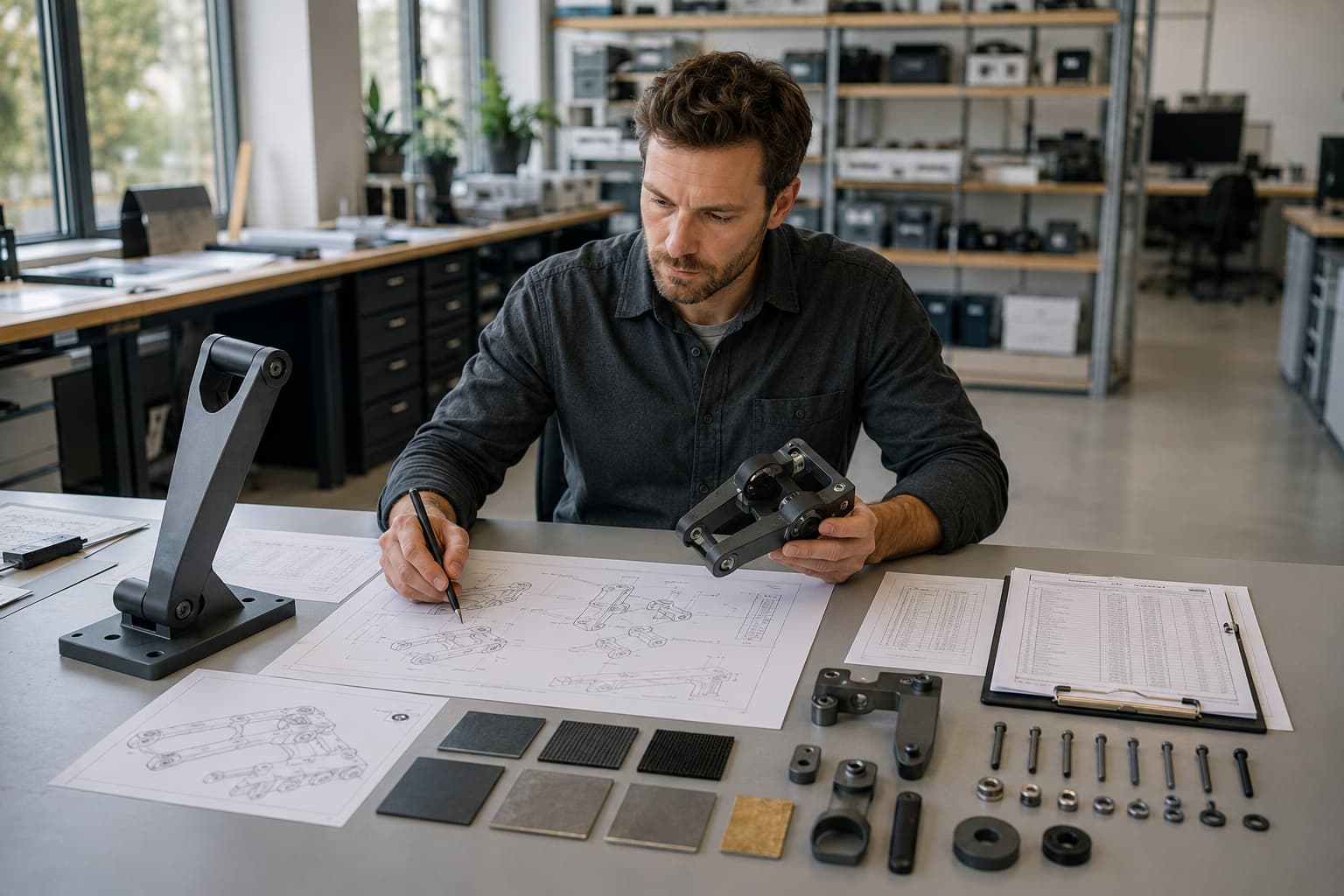
A manufacturer needs more than a three-dimensional model. Product engineering creates the controlled documentation that tells suppliers what to build and how the finished product should be evaluated.
Common engineering deliverables include:
- Released CAD files
- Two-dimensional engineering drawings
- Critical dimensions and tolerances
- Material and finish specifications
- Bill of materials
- Approved component and supplier lists
- Assembly instructions
- Functional test procedures
- Inspection and quality requirements
- Firmware versions and programming instructions
- Revision history and change records
Revision control prevents suppliers and internal teams from working from different versions. It also creates a record of what changed, why it changed, and which units are affected.
This documentation becomes increasingly important as the product advances from a small engineering team into outside sourcing, manufacturing, quality control, fulfillment, and support.
Manufacturing and Supplier Support
Engineering work often continues after a design package is released. Manufacturers may identify process limitations, request substitutions, suggest geometry changes, or discover that a specified tolerance cannot be maintained economically.
Product engineers review those requests and determine how the proposed changes could affect performance, appearance, compliance, assembly, or long-term reliability.
Engineering support during manufacturing may include:
- Responding to supplier technical questions
- Reviewing manufacturing feedback
- Approving material or component substitutions
- Evaluating first articles and pilot units
- Resolving quality or assembly problems
- Updating drawings and bills of materials
- Investigating field failures
- Supporting cost-reduction revisions
The goal is not to reject every manufacturing change. It is to make sure changes are evaluated deliberately and documented correctly.
When Do You Need Product Engineering Services?
Outside product engineering support can enter a project at several different points. You may need it when:
- You have a concept or sketch but no technical product definition.
- Your prototype proves the idea but is not ready for manufacturing.
- A key mechanical, electrical, or firmware problem remains unresolved.
- Your internal team lacks one of the required engineering disciplines.
- Mechanical and electrical development are not staying coordinated.
- Your prototype works inconsistently or fails under realistic conditions.
- The product is becoming too expensive or difficult to assemble.
- A manufacturer is asking for drawings, tolerances, or specifications you do not have.
- You need production-ready documentation and revision control.
- Your team needs experienced technical leadership without hiring a full internal department.
Engineering support is most effective when it begins before a project is locked into major tooling, inventory, or supplier commitments. However, an experienced team can also review an existing design, diagnose problems, and create a recovery plan.
Common Product Engineering Engagement Models
Not every project requires a complete outsourced engineering program. Product engineering services can be structured around the actual gap.
Focused Technical Project
The engineering team addresses one defined problem, such as redesigning a mechanism, developing a circuit board, resolving thermal issues, or preparing production drawings.
Engineering Gap Support
An outside specialist supplements the internal team with a missing discipline or capability. For example, a mechanical team may need electrical engineering, firmware, simulation, or manufacturing expertise.
Integrated Engineering Workstream
A multidisciplinary outside team manages mechanical, electrical, firmware, prototype, and documentation work while coordinating with the client’s product, business, or manufacturing teams.
Full Product Development Partnership
Engineering is integrated with product strategy, industrial design, prototyping, sourcing, manufacturing preparation, and commercialization. The difference between a narrow design vendor and this broader relationship is discussed in Product Design Company in Utah vs. Full Product Development Partner.
How to Evaluate a Product Engineering Partner
A strong engineering partner should be able to explain how its work connects to the product’s business, user, and manufacturing requirements.
Ask potential partners about:
- Experience with similar product types and technologies
- Available mechanical, electrical, firmware, and manufacturing expertise
- How requirements and technical decisions are documented
- Prototype and testing capabilities
- Design review and quality-control processes
- How disciplines coordinate with one another
- How project changes affect budget and schedule
- Ownership and delivery of engineering files
- Confidentiality and intellectual property practices
- Support available during manufacturing and after launch
Be cautious when a provider recommends detailed solutions before understanding the product requirements. Engineering decisions should follow the product’s function, risks, user needs, manufacturing goals, and commercial constraints.
Product Engineering Connects the Idea to Production
Product engineering services create the technical foundation that allows a physical product to move forward with confidence. They turn ideas into requirements, requirements into designs, designs into prototypes, and validated prototypes into controlled manufacturing documentation.
The exact services needed depend on the product and its current stage. Some teams need help solving one technical problem. Others need a coordinated engineering group that can manage the complete system.
In either case, the objective is the same: create a product that functions as intended, can be built consistently, and is supported by evidence and documentation rather than assumptions.
Bring the Right Engineering Expertise Into Your Product
Ahdept helps founders and product teams define requirements, solve mechanical and electrical challenges, develop and test prototypes, and prepare physical products for manufacturing.
Our Office
450 N. Flint Street
Kaysville, UT 84037, USA
Contact Us
(385) 566-1877
info@ahdept.com
Careers
Office Hours
Mon-Fri: 8am - 5pm
Sat-Sun: Closed